

A Game of Thrones
George R. R. Martin
Fourth Wing
Rebecca Yarros
Harry Potter and the Sorcerer's Stone
J.K. Rowling
Mistborn: The Final Empire
Brandon Sanderson
The Lies of Locke Lamora
Scott Lynch
The Name of the Wind
Patrick Rothfuss
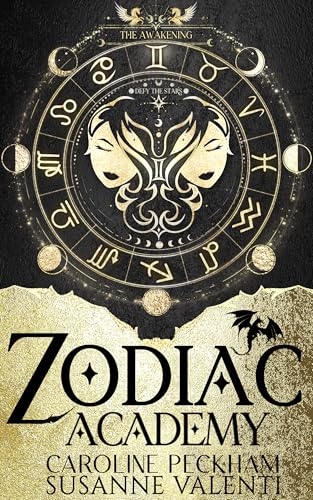
Zodiac Academy: The Awakening
Caroline Peckham, Susanne Valenti
Caroline Peckham, Susanne Valenti
Zodiac Academy: The Awakening
Caroline Peckham, Susanne Valenti
Fantasy
Bully romance / academy romantasy
2019
8
7
Twin sisters scraping by in the mortal world are told they are the lost heirs to a Fae kingdom and enrolled at a magical academy, where the four young lords currently holding the throne set out to break them into signing their claim away.
Two penniless orphans inherit a throne that four powerful families have already divided between them, and the school they are sent to is the arena where the dispute gets settled.
A boarding-school succession war fought as sustained hazing.
Darcy and Tory Vega, split duty. Darcy absorbs and endures; Tory escalates and retaliates. Neither has magical training, money, or an adult who will intervene.
The four Celestial Heirs — Darius Acrux, Seth Capella, Max Rigel, Caleb Altair — who are not sadists first but claimants. Their campaign has an objective, and the faculty treat their authority as legitimate.
Character core
To survive the term, learn to use magic they did not know they had, and refuse to sign away the inheritance.
To stop treating the claim as a lottery ticket and recognise it as a position they will have to hold by force, and to accept that the one thing they cannot be stripped of is each other.
If we keep our heads down and get through this, they will lose interest and let us have a normal year.
There is no version of staying that does not involve fighting back. Endurance reads to the Heirs as an invitation, and the only currency the school respects is demonstrated power.
Expulsion, abdication, and — once the hazing turns physical — death, with no guardian, no appeal, and no route back to the mortal world worth taking.
Structure
First person, alternating between Darcy and Tory, each chapter headed with the sister's name. The split lets one sister absorb an attack while the other watches it happen, so the same event is delivered twice in different registers.
The academy calendar supplies the spine: arrival, elemental house sorting, a class timetable, Pitball fixtures, and the Awakening ceremony announced early as a scheduled capstone every student must face. Against that fixed schedule the authors run a standing offer — renounce the claim and leave — which is repeated at intervals and refused each time, so the book has a clock without a countdown. The alternating sisters keep two fronts open, which means neither POV has to carry a slow stretch. Escalation is managed by moving the hazing from public embarrassment to physical danger to institutionally sanctioned violence, with the Awakening as the point where all three converge.
Two Fae arrive in the mortal world to tell the twins they are not human, their father was the late king of Solaria, and there is a place waiting for them at Zodiac Academy.
The demand to renounce the claim is put to them directly and they refuse it. That refusal converts the Heirs' programme from hazing meant to drive them out into a campaign meant to break them, and the twins stop treating the school as somewhere to survive and start treating it as somewhere to win.
The escalation reaches a point the faculty will not check — the Heirs' standing is part of the institution, not a violation of it — and the twins go into the Awakening knowing that the people running the ceremony want them to fail it.
The Awakening itself. The ritual requires being driven to the edge of death so that magical reserves expand, and the Heirs administer it, inflicting drowning, burning, and burial. The twins survive it rather than breaking, and come out of it with reserves that outstrip every student in the school.
They do not leave. The Heirs' attempt to destroy them has instead made them the only credible threat to the four houses' hold on the throne, and the claim is still unsigned when the term ends.
Story beats
| Beat | Where | How it lands |
|---|---|---|
An offer they should refuse and don't | Act I, the recruitment visit | The twins accept a throne claim from strangers who will not explain what it costs. Because they consent on the page, every subsequent attack is something they walked into. |
A door closed behind them | Act I, arrival at the academy | The mortal life behind them was poverty, foster care, and no fixed address, so there is nothing to retreat to. The book never has to answer why they don't just go home. |
The rules bent once, then bent again | Throughout | The Heirs move from public embarrassment to physical harm in increments, each one only slightly worse than the last, so the reader arrives at sanctioned near-murder having accepted every step. |
An enemy shows unexpected decency | Middle, in isolated scenes with Darius and Caleb | One Heir intervenes or pulls a punch without explaining why, which makes the campaign harder to read as simple villainy and seeds both romance lines. |
Public humiliation that fuels everything after | Early, the first group humiliation in front of the student body | The audience is the point — the Heirs need the school to see the twins as illegitimate, and the twins spend the rest of the book working off the impression. |
Fighting someone who isn't trying | Early to middle, elemental combat lessons | The Heirs beat them without extending themselves, which sets a visible ceiling and makes every later gain measurable against it. |
Discovering the ranking system is rigged | Middle | The faculty do not merely fail to intervene — they treat Heir authority as part of the school's order, so the hierarchy itself is the antagonist and cannot be reported to anyone. |
Learning the founding story is propaganda | Middle, as the twins learn their father's history | The official account of the Savage King is the version told by the families who replaced him, which gives the twins reason to distrust everything the academy teaches about their own inheritance. |
An offer they should refuse and don't
The twins accept a throne claim from strangers who will not explain what it costs. Because they consent on the page, every subsequent attack is something they walked into.
A door closed behind them
The mortal life behind them was poverty, foster care, and no fixed address, so there is nothing to retreat to. The book never has to answer why they don't just go home.
The rules bent once, then bent again
The Heirs move from public embarrassment to physical harm in increments, each one only slightly worse than the last, so the reader arrives at sanctioned near-murder having accepted every step.
An enemy shows unexpected decency
One Heir intervenes or pulls a punch without explaining why, which makes the campaign harder to read as simple villainy and seeds both romance lines.
Public humiliation that fuels everything after
The audience is the point — the Heirs need the school to see the twins as illegitimate, and the twins spend the rest of the book working off the impression.
Fighting someone who isn't trying
The Heirs beat them without extending themselves, which sets a visible ceiling and makes every later gain measurable against it.
Discovering the ranking system is rigged
The faculty do not merely fail to intervene — they treat Heir authority as part of the school's order, so the hierarchy itself is the antagonist and cannot be reported to anyone.
Learning the founding story is propaganda
The official account of the Savage King is the version told by the families who replaced him, which gives the twins reason to distrust everything the academy teaches about their own inheritance.
Tropes
The claim arrives as pure threat — it makes the twins targets before it makes them anything else, and they have no training, allies, or institutional support to defend it with.
Star signs, elemental houses, Orders, and a Pitball fixture list give the school a rule set the plot runs on, and the timetable does the act-break work.
The institution sides with the aggressors by design rather than negligence, because the Heirs' families fund and outrank it.
The antagonism is structural — the Heirs lose their thrones if the twins keep theirs — so the opposition cannot be cleared up by conversation, only by one side giving something up.
The twins arrive with no money, no wardrobe, and no name, and the book keeps the economics visible: the Heirs can afford generosity and cruelty alike, the twins can afford neither.
The starting weakness is genuine and socially enforced — no magic, no Order, no standing — and the Awakening is the threshold that converts effort into a measurable jump.
Magic is metered by a reserve that depletes and must be refilled, and the Awakening's whole premise is that the ceiling only rises by being driven to the edge of death.
Craft notes
Two protagonists under the same siege is a load-distribution device. Because Darcy takes the humiliation and Tory takes the rage, neither sister has to be both victim and aggressor, which is the contradiction that sinks most single-lead bully romances. The split also lets the authors run two romances at different speeds with no love triangle and no jealousy plot. If your protagonist has to be both passive enough to be brutalised and active enough to be worth reading, consider whether the role should be two people.
Imitators reproduce the cruelty and drop the reason for it. The Heirs want a specific, legally consequential thing — a signature renouncing the claim — and every act of violence is an attempt to obtain it, which means the twins can counter it, refuse it, and raise its cost. Cruelty without a stated objective is just abuse the reader is later asked to forgive. The second omission is leverage: the twins hold something the Heirs actually need, so the power gap is not total and the reader is never watching a one-way beating.
Drop this structure into a project, set a daily word goal, and keep the streak. Free 14-day Pro trial, no credit card.