
Blood Meridian
Cormac McCarthy
Lonesome Dove
Larry McMurtry

Riders of the Purple Sage
Zane Grey
Shane
Jack Schaefer
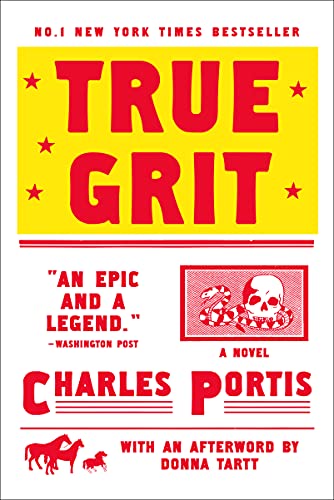
True Grit
Charles Portis
Charles Portis
True Grit
Charles Portis
Western
Western
1968
6
6
A fourteen-year-old girl travels to Fort Smith to collect her murdered father's body and stays to hire the meanest available deputy marshal to hunt the killer into Indian Territory.
A girl hires a drunk marshal to avenge her father and insists on going along.
A revenge western narrated in old age by a woman who has never once conceded a point.
Mattie Ross — fourteen, litigious, devout, and completely certain.
Tom Chaney, who is a stupid, frightened man rather than a formidable one — which is part of the point.
Character core
To see Tom Chaney hanged, and to be present when it happens.
The novel declines to give her one. Mattie does not change, and the coda's revelation of an unmarried, one-armed, prosperous, solitary old woman is offered without editorial comment.
Everything can be settled if you are righteous enough and refuse to be moved — a position the book never explicitly refutes.
Withheld. Portis lets the coda do the arithmetic: she got what she wanted and it cost her an arm and, by implication, a life.
Chaney escaping into the Territory; Mattie's own life once she insists on riding along; and the money her family cannot spare.
Structure
First person retrospective by Mattie Ross, in a formal, scriptural, entirely unironic Presbyterian voice that is the funniest thing in the book.
Short, linear, and pursuit-driven. Portis compresses the whole affair into a few weeks and then adds a brief coda twenty-five years later that reframes it. The narration is the technique: an elderly Mattie recounting events with total confidence, so that the comedy and the horror both arrive through the same unbending register.
Frank Ross is shot by his hired man over nothing, and Mattie arrives in Fort Smith to handle the arrangements.
Mattie forces her way across the river and into the pursuit, converting a hired job into a shared one that Rooster and LaBoeuf cannot control.
Mattie finds Chaney at the water and shoots him, and the recoil drops her into a pit of rattlesnakes with a broken arm.
Rooster's charge across the meadow at Ned Pepper's four riders with the reins in his teeth — an act of pure, obsolete gallantry.
Rooster rides Little Blackie to death getting Mattie to a doctor. The arm is lost. Twenty-five years later Mattie collects Rooster's body from a travelling show and buries it in her family plot.
Story beats
| Beat | Where | How it lands |
|---|---|---|
The saloon or store extending credit | Act I | Mattie out-negotiates Colonel Stonehill over ponies in the book's best comic sequence and funds the pursuit with it. |
Two allies who hate each other, forced to cooperate | Throughout | Rooster and LaBoeuf detest each other and are stuck with each other and with her. |
A hanging attended by the whole town | Act I | The triple hanging in Fort Smith is attended by the whole town, with speeches. |
The doctor is sixty miles away | Climax | The nearest doctor is a night's hard ride away, and the horse does not survive it. |
Weather as antagonist for a full chapter | Middle | Cold and the Territory's distances do most of the damage before any shooting starts. |
Returning to the starting place, changed | Coda | Mattie returns to collect a body twenty-five years later, and the frontier has become a travelling show. |
The saloon or store extending credit
Mattie out-negotiates Colonel Stonehill over ponies in the book's best comic sequence and funds the pursuit with it.
Two allies who hate each other, forced to cooperate
Rooster and LaBoeuf detest each other and are stuck with each other and with her.
A hanging attended by the whole town
The triple hanging in Fort Smith is attended by the whole town, with speeches.
The doctor is sixty miles away
The nearest doctor is a night's hard ride away, and the horse does not survive it.
Weather as antagonist for a full chapter
Cold and the Territory's distances do most of the damage before any shooting starts.
Returning to the starting place, changed
Mattie returns to collect a body twenty-five years later, and the frontier has become a travelling show.
Tropes
Completed successfully, at a cost the coda states without comment.
Mattie is the outsider and she refuses to be educated, and is largely vindicated.
Parker's court and Rooster's methods are contrasted throughout, and neither is endorsed.
Rooster is not trying to retire; he is already obsolete and drinking through it.
The Territory's cold and distance shape every decision in the pursuit.
Mattie's coda life is one of property, banking, and refusal, which is its own kind of frontier.
Craft notes
Portis lets Mattie's voice carry the entire book without a single moment of authorial commentary. She reports her own inflexibility as virtue, her own losses as arithmetic, and the reader supplies everything else. A narrator who never editorialises about themselves gives the reader something to do, and readers reward it.
Retrospective narration usually smooths its subject. Mattie at sixty is exactly the person she was at fourteen, which is the coda's quiet devastation — the voice has not learned anything, and the reader has.
Drop this structure into a project, set a daily word goal, and keep the streak. Free 14-day Pro trial, no credit card.