
Dracula
Bram Stoker
Frankenstein
Mary Shelley

Mexican Gothic
Silvia Moreno-Garcia
The Haunting of Hill House
Shirley Jackson
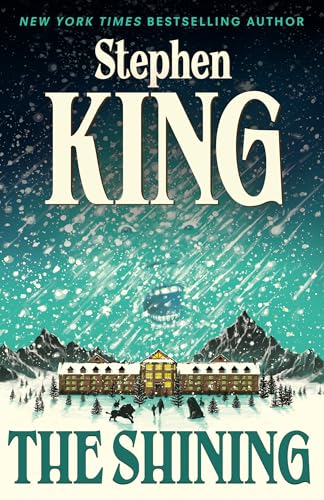
The Shining
Stephen King
Stephen King
The Shining
Stephen King
Horror
Haunted house / psychological horror
1977
6
6
A recovering alcoholic takes a winter caretaking job at an isolated Colorado hotel, hoping to write and repair his family, and the hotel begins working on him through his son's psychic gift and his own resentment.
A father with a temper is sealed into an empty hotel with his wife and son for five months.
A domestic-abuse novel with a supernatural accelerant, in which the ghosts are real and also entirely unnecessary.
Jack Torrance — sober, remorseful, genuinely loving, and carrying a violence he has not resolved. He is a tragedy, not a monster.
The Overlook, which works through Jack's grievances rather than against them.
Character core
To keep the job, finish the play, stay sober, and be the father his own father was not.
To acknowledge that the resentment is his own and pre-existing, rather than something the hotel installed.
I have it under control. The drinking is behind me, the arm was an accident, and this job is the thing that fixes everything.
Arrives too late and only in fragments — the flicker at the climax where Jack surfaces long enough to warn his son is the only moment the man wins.
Danny's life and Danny's gift, which the hotel wants; and Jack's soul, in the older and more literal sense.
Structure
Third person limited, rotating among Jack, Wendy, Danny, and briefly Hallorann, past tense, with italicised intrusions rendering Danny's precognition and Jack's internal voice.
Snow is the clock. The book establishes early that the road closes, so the first act's dread is entirely anticipatory — the reader watches a family walk voluntarily into a place they cannot leave. King then escalates on two curves at once: the hotel's manifestations and Jack's relapse, which are deliberately hard to separate.
Jack takes the caretaker job despite the previous caretaker's murder-suicide, and Hallorann warns Danny about Room 217 and about the hotel's memory.
The manifestations stop being ambiguous. The topiary animals move, and the reader can no longer read the haunting as Jack's deterioration alone.
The radio and the snowmobile are destroyed, Jack has been drinking at a bar that does not exist, and Wendy and Danny are alone in a building with a man who is no longer entirely their husband and father.
Jack pursues Danny with a roque mallet, Danny confronts him with the truth that the thing wearing his father is not his father, and Jack surfaces long enough to let the boiler go.
The Overlook is destroyed, Jack with it, and Hallorann takes Wendy and Danny out. Danny's grief is for his father, not his escape.
Story beats
| Beat | Where | How it lands |
|---|---|---|
A locked door found open | Middle | Room 217 is locked, then not, and the discrepancy is the first thing nobody can explain away. |
The safe place used up | Act III | The apartment, the kitchen, and finally the whole hotel are used up as safe spaces one by one. |
The phone works, and nobody believes them | Middle | The radio is destroyed, and with it the last route to anyone who would believe them. |
A rescue that arrives and is absorbed | Act III | Hallorann's rescue arrives and is nearly absorbed by the hotel before it can function. |
A daylight scene worse than any night scene | Middle | Some of the worst scenes occur in bright snow-light through large windows. |
Someone who was right all along, ignored | Act I | Hallorann warns Danny precisely and accurately, and nothing about the warning helps. |
A locked door found open
Room 217 is locked, then not, and the discrepancy is the first thing nobody can explain away.
The safe place used up
The apartment, the kitchen, and finally the whole hotel are used up as safe spaces one by one.
The phone works, and nobody believes them
The radio is destroyed, and with it the last route to anyone who would believe them.
A rescue that arrives and is absorbed
Hallorann's rescue arrives and is nearly absorbed by the hotel before it can function.
A daylight scene worse than any night scene
Some of the worst scenes occur in bright snow-light through large windows.
Someone who was right all along, ignored
Hallorann warns Danny precisely and accurately, and nothing about the warning helps.
Tropes
The Overlook has a documented history, a personality, and an appetite, and it recruits rather than attacks.
The snow is established months in advance, so the isolation is a countdown rather than a contrivance.
Gradual, partial, and contested — Jack keeps resurfacing, which is what makes it a tragedy.
Jack's deterioration has an internal logic the reader can follow, which is why it is frightening rather than random.
Danny's gift makes him the most perceptive and least dangerous person in the hotel; the Grady girls carry the conventional version.
The hotel's history is disclosed at the job interview, and Jack takes the job anyway.
Craft notes
King establishes Jack's violence in backstory — the broken arm, the student he assaulted — before any supernatural event occurs, so the reader is already afraid of him. The hotel never has to make Jack dangerous; it only has to stop him resisting. Give your possessed character a pre-existing capacity for the thing they will do.
Haunted-house novels usually make the house's manifestations the escalation. Here the escalation is a marriage deteriorating, and the ghosts are pressure applied to an existing fault. A house with no one to work on has nothing to do.
Drop this structure into a project, set a daily word goal, and keep the streak. Free 14-day Pro trial, no credit card.