

Six of Crows
Leigh Bardugo

Speak
Laurie Halse Anderson

The Fault in Our Stars
John Green
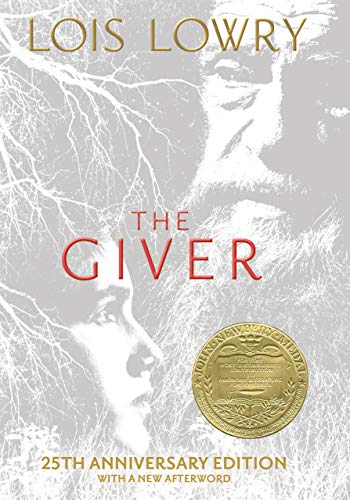
The Giver
Lois Lowry

The Hunger Games
Suzanne Collins
Lois Lowry
The Giver
Lois Lowry
YA
Dystopian middle-grade / YA
1993
7
6
In a community that has eliminated war, hunger, colour, and choice, a twelve-year-old is selected to be the sole bearer of humanity's memories and learns what his neighbours have traded away and what happens to the children they release.
A boy is given the only memory of the world before, and cannot un-know it.
A short, plain dystopia that withholds its central atrocity until the reader has already accepted the community as pleasant.
Jonas — obedient, precise, and possessed of a capacity to see beyond that nobody has language for.
The Community's Elders, who are neither cruel nor mistaken by their own lights.
Character core
To perform his assignment well and understand what is being given to him.
To decide whether knowledge that cannot be shared is worth having, and to act on it at cost.
The Community's choices were made by wise people for good reasons. Sameness is safety.
Release is killing. The Community's peace is purchased with a routine infanticide and euthanasia that its own citizens do not understand they are performing, because the language was engineered to prevent it.
Gabriel's scheduled release; and, if Jonas leaves, the return of all the memories to a population with no capacity to hold them.
Structure
Third person limited on Jonas, past tense, in deliberately flat, precise prose that mirrors the community's language rules.
The transfer of memories is the delivery mechanism for both worldbuilding and escalation: each memory Jonas receives is more intense than the last, and the reader's understanding grows at exactly his pace. Lowry places the release scene — Jonas watching his father kill an infant — deep in the third act, after two hundred pages of civic pleasantness.
At the Ceremony of Twelve, Jonas is not assigned but selected — as Receiver of Memory.
Colour. Jonas begins to see red, and the Community's Sameness is revealed as a subtraction rather than an absence.
Jonas watches the recording of his father releasing the smaller twin, and understands both what release is and that Gabriel is scheduled for it.
Jonas takes Gabriel and flees toward Elsewhere, which will release the memories back into the Community whether or not he survives.
The sled, the lights, the music — an ending that can be read as arrival or as hypothermic death, and Lowry has consistently declined to settle it.
Story beats
| Beat | Where | How it lands |
|---|---|---|
The truth told and not believed | Late | Jonas cannot explain what he knows, because the vocabulary required has been removed from the language. |
A reveal that recontextualizes an earlier scene | Act III | The meaning of 'release' recontextualises every civic ceremony in the book. |
A door closed behind them | Climax | Leaving is irreversible for Jonas and for the Community, which will receive everything he was carrying. |
Losing something small and irreplaceable | Middle | The memory of a sled, an elephant, and a grandmother are the losses that make the abstractions land. |
Choosing which records survive | Throughout | One person holds all the records, by design, so that nobody else has to. |
Discovering a parent's secret | Act III | Jonas discovers what his father actually does at work. |
The mentor turns out to be fallible | Late | The Giver admits he failed the last Receiver, and the admission is what makes the escape plan possible. |
The truth told and not believed
Jonas cannot explain what he knows, because the vocabulary required has been removed from the language.
A reveal that recontextualizes an earlier scene
The meaning of 'release' recontextualises every civic ceremony in the book.
A door closed behind them
Leaving is irreversible for Jonas and for the Community, which will receive everything he was carrying.
Losing something small and irreplaceable
The memory of a sled, an elephant, and a grandmother are the losses that make the abstractions land.
Choosing which records survive
One person holds all the records, by design, so that nobody else has to.
Discovering a parent's secret
Jonas discovers what his father actually does at work.
The mentor turns out to be fallible
The Giver admits he failed the last Receiver, and the admission is what makes the escape plan possible.
Tropes
The community works, its citizens are content, and the cost is disclosed only to the reader and one child.
The Ceremony of Twelve assigns every child a life, and Jonas's selection is the exception that breaks it.
The whole population has been relieved of memory, and one person is required to carry it for them.
A single child acting alone, with no movement and no allies but one old man.
The Giver is fallible, exhausted, and complicit, and says so.
The releases are administrative rather than ritual, which is more disturbing than a ceremony would be.
Craft notes
Lowry builds the entire book on the reader's understanding of a single word. 'Release' is used dozens of times in ordinary contexts before its meaning is disclosed, so the reveal retroactively poisons every earlier page. Choose one euphemism, use it neutrally throughout, and detonate it late.
Dystopias usually establish oppression early to give the reader an enemy. Lowry's Community is genuinely pleasant for two hundred pages — the family unit is warm, the schooling is kind — which is why the reveal is devastating and why readers argue about it for decades.
Drop this structure into a project, set a daily word goal, and keep the streak. Free 14-day Pro trial, no credit card.