

All the Light We Cannot See
Anthony Doerr

Lessons in Chemistry
Bonnie Garmus
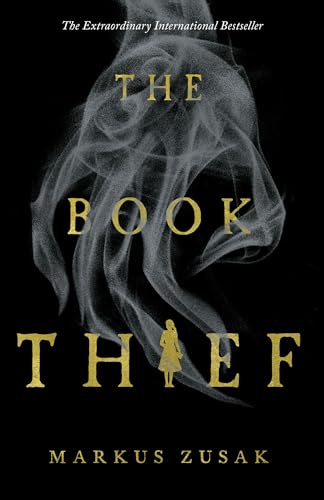
The Book Thief
Markus Zusak

The Help
Kathryn Stockett

The Nightingale
Kristin Hannah
Markus Zusak
The Book Thief
Markus Zusak
Historical
Historical fiction / World War II
2005
7
6
Narrated by Death, the story of a girl fostered to a working-class couple in a small German town, who steals books, learns to read, and helps hide a Jewish man in the basement while the war closes in.
Death tells the story of a German girl who steals books during the Nazi period.
A wartime childhood narrated by an exhausted, compassionate personification of mortality.
Liesel Meminger — nine at the opening, illiterate, and grieving a brother whose funeral is the book's first image.
The Nazi state, rendered mostly through ordinary compliance rather than through officials.
Character core
To keep her foster family, learn to read, and hold on to the people she has left.
To find something that survives the war and the bombs — which is, in this book's argument, language.
If I hold tightly enough to the people I love, they will not be taken.
Words are what the Nazis used and what saved her, and they are the only thing she can keep. The book she writes is what survives Himmel Street.
Discovery of Max in the basement, the Hubermanns' arrest, and — announced in advance by Death — the destruction of everyone on the street.
Structure
First person by Death, past tense, with bolded interjections and a habit of announcing deaths long before they occur.
Structured by the books Liesel steals — each section is titled for a text — with Death's spoilers deployed as a deliberate anti-suspense device. Zusak announces the ending early and repeatedly, which converts the reading experience from anticipation into dread and grief. The bolded asides are the book's most distinctive formal feature.
Liesel's brother dies on the train, and at his graveside she picks up a gravedigger's handbook.
Max arrives, and the household's ordinary poverty becomes a capital crime that must be maintained daily.
Max leaves to protect them, Hans is conscripted, and Death has already told the reader what the bombs will do to Himmel Street.
The bombing. Liesel is in the basement writing, which is the only reason she survives, and she comes up to find everyone she loves dead in the street.
Death carries the souls and keeps her manuscript. The final line — Death's admission about human beings — is the book's whole thesis in one sentence.
Story beats
| Beat | Where | How it lands |
|---|---|---|
Losing something small and irreplaceable | Throughout | Specific small objects — an accordion, a book, a snowman in a basement — carry grief the war's scale cannot. |
A soldier billeted in the house | Middle | Max in the basement inverts the billeting beat: the hidden guest is the one at risk. |
Conscription notice | Late | Hans's conscription is punishment for a moment of public decency, and it is delivered as paperwork. |
Learning to read, or hiding that they can | Act I | Liesel's learning to read in the basement with Hans is the book's central act of resistance. |
An enemy shows unexpected decency | Middle | Hans gives bread to a Jewish prisoner in a march, and pays for it for the rest of the book. |
The strike, riot, or bread queue | Throughout | Rationing, queues, and the mayor's wife's library define the town's economy of scarcity and privilege. |
The first real loss — small, not the big one | Act I | The brother's death on the train, on page one, establishes the book's terms before the reader is invested. |
Losing something small and irreplaceable
Specific small objects — an accordion, a book, a snowman in a basement — carry grief the war's scale cannot.
A soldier billeted in the house
Max in the basement inverts the billeting beat: the hidden guest is the one at risk.
Conscription notice
Hans's conscription is punishment for a moment of public decency, and it is delivered as paperwork.
Learning to read, or hiding that they can
Liesel's learning to read in the basement with Hans is the book's central act of resistance.
An enemy shows unexpected decency
Hans gives bread to a Jewish prisoner in a march, and pays for it for the rest of the book.
The strike, riot, or bread queue
Rationing, queues, and the mayor's wife's library define the town's economy of scarcity and privilege.
The first real loss — small, not the big one
The brother's death on the train, on page one, establishes the book's terms before the reader is invested.
Tropes
The German home front specifically, which is the book's most valuable and least common vantage.
Resistance here is domestic, small-scale, and mostly futile — bread, a basement, a name not reported.
A communist mother who disappears, a dead brother, and foster parents who become the real ones.
The book opens with a child's funeral and never leaves that register entirely.
Max's painted-over Mein Kampf and Liesel's own manuscript are both physical objects in the plot.
The books themselves are the forbidden documents, and reading them aloud is the transgression.
Craft notes
Zusak gives away every death in advance, and the book is more devastating for it. Announced loss converts every subsequent ordinary scene into an elegy, so a boy asking for a kiss becomes unbearable. If your ending is a bereavement, consider telling the reader early and letting them grieve throughout.
Novelty narrators usually cost more than they earn. Death works here because he has a consistent psychology, a workload, and an aesthetic — he notices colours because he cannot bear to look at faces. A gimmick narrator needs an interior life, not just a voice.
Drop this structure into a project, set a daily word goal, and keep the streak. Free 14-day Pro trial, no credit card.