
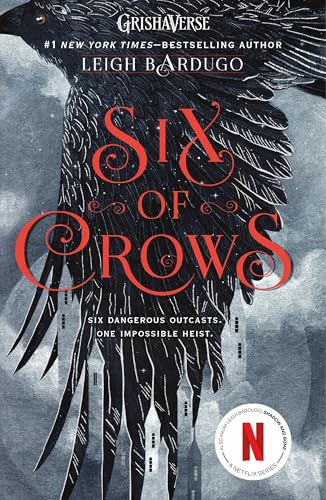
Six of Crows
Leigh Bardugo

Speak
Laurie Halse Anderson

The Fault in Our Stars
John Green

The Giver
Lois Lowry

The Hunger Games
Suzanne Collins
Leigh Bardugo
Six of Crows
Leigh Bardugo
YA
YA fantasy heist
2015
7
6
A teenage criminal from the slums of a mercantile city is offered an impossible sum to break a scientist out of the world's most secure fortress, and assembles five other outcasts each of whom has a private reason to fail.
Six damaged teenagers rob an unrobbable fortress, and every one of them is lying to the others.
A caper novel with five viewpoint characters, each carrying a full backstory.
Kaz Brekker — seventeen, brilliant, and physically unable to tolerate touch.
Jan Van Eck, who commissions the job and betrays them; and jurda parem as the thing nobody should have.
Character core
The money — thirty million kruge — and, underneath it, the resources to destroy Pekka Rollins.
To let the crew be people he owes something to rather than pieces he deploys, which the book advances rather than resolves.
I do not need anyone. Attachment is leverage that other people can use on me.
Partial: Kaz's refusal to name what Inej is to him is presented as the flaw the sequel will address, and the book ends with the debt unpaid.
The crew's lives; Inej's indenture; and the release of a drug that would make the Grisha into slaves worldwide.
Structure
Third person limited, rotating among five of the six, past tense. Kaz's chapters withhold his plan; the others withhold their histories.
Standard heist architecture — job, crew, plan, execution, betrayal — with the innovation that each crew member's backstory is released mid-heist, so exposition arrives at maximum tension rather than in an assembly montage. Bardugo also withholds the plan from the reader deliberately, and pays for it by making the character revelations the actual payoff.
Van Eck offers Kaz an impossible job for an impossible fee, and Kaz accepts before he has any idea how.
Inside the Ice Court, the plan begins failing in ways that expose each crew member's private agenda — Nina and Matthias's history, Wylan's parentage, Jesper's debts.
The extraction goes wrong, the crew is separated, and Van Eck reveals he never intended to pay and has taken Inej.
The escape from the Ice Court by incinerator shaft, and the realisation on the docks that the job succeeded and the payment was always a lie.
The crew survives, Inej is captured, and Kaz declares his intention to get her back — a cliffhanger that reframes the money as irrelevant.
Story beats
| Beat | Where | How it lands |
|---|---|---|
Two allies who hate each other, forced to cooperate | Throughout | Nina and Matthias are a Grisha and a Grisha-hunter forced to cooperate, and neither has forgiven the other. |
An ally's private agenda surfaces | Throughout | Every crew member is running a private agenda, and the book withholds them until each becomes load-bearing. |
A favor called in at the worst possible time | Middle | Old debts — Jesper's gambling, Kaz's history with Rollins — come due at the least survivable moment. |
A door closed behind them | Act II | Entry into the Ice Court is one-way by design, which is why the plan has no fallback. |
The friend group's fracture point | Middle | The crew fractures under pressure along exactly the lines their histories predicted. |
An old wound reopened by a stranger | Throughout | Each character's worst memory is reopened by the job's specific requirements. |
A debt paid in the wrong currency | Resolution | The payment never arrives, and what Kaz owes Inej cannot be settled in kruge. |
Two allies who hate each other, forced to cooperate
Nina and Matthias are a Grisha and a Grisha-hunter forced to cooperate, and neither has forgiven the other.
An ally's private agenda surfaces
Every crew member is running a private agenda, and the book withholds them until each becomes load-bearing.
A favor called in at the worst possible time
Old debts — Jesper's gambling, Kaz's history with Rollins — come due at the least survivable moment.
A door closed behind them
Entry into the Ice Court is one-way by design, which is why the plan has no fallback.
The friend group's fracture point
The crew fractures under pressure along exactly the lines their histories predicted.
An old wound reopened by a stranger
Each character's worst memory is reopened by the job's specific requirements.
A debt paid in the wrong currency
The payment never arrives, and what Kaz owes Inej cannot be settled in kruge.
Tropes
Crew assembly, infiltration, betrayal — executed with the plan deliberately withheld from the reader.
The crew is a family none of them will admit to, and the refusal is the characterisation.
Kaz's criminality is a profession with a method, a reputation, and a cost.
The crew's splits happen under operational pressure and are never fully repaired.
Every member is an orphan, a runaway, or the child of someone actively harming them.
Nina and Matthias, with a genuinely structural antagonism — she had him imprisoned.
Craft notes
Bardugo distributes the backstory into the heist. Each flashback triggers at the moment its content becomes operationally relevant — Nina's history with Matthias detonates when they need him, Kaz's with Rollins when the plan requires it. If you have six characters' worth of backstory, do not front-load it; hold each until the plot makes it urgent.
Withholding the plan from the reader is a licence to solve problems retroactively, and most heist novels abuse it. Bardugo compensates by making the emotional revelations the payoff rather than the cleverness, so the reader is rewarded even when 'we planned for that' does the plot work.
Drop this structure into a project, set a daily word goal, and keep the streak. Free 14-day Pro trial, no credit card.