
Blood Meridian
Cormac McCarthy
Lonesome Dove
Larry McMurtry

Riders of the Purple Sage
Zane Grey
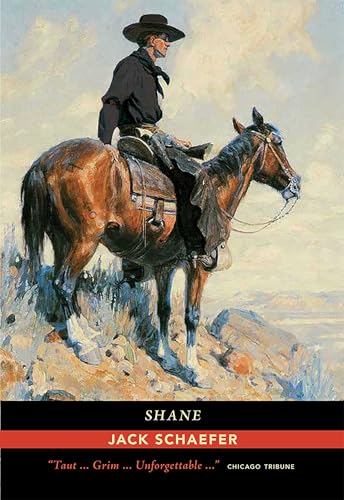
Shane
Jack Schaefer
True Grit
Charles Portis
Jack Schaefer
Shane
Jack Schaefer
Western
Classic western
1949
7
6
A quiet stranger rides into a Wyoming valley in 1889, takes work on a homesteader's farm, and stays as a cattle baron escalates his campaign to drive the smallholders off land he considers his.
A gunfighter tries to stop being one, and a family's survival requires him to fail.
The template western, told by a child who does not understand most of what he is describing.
Shane in the plot; Bob Starrett as narrator and the one the story is being told for.
Fletcher, the cattleman, and Wilson, the gunman he imports when intimidation stops working.
Character core
To work, to be useful, and to be left alone as an ordinary man.
To accept that he cannot be what he wants to be here, and that staying would poison the family he has come to love.
A man can put down what he was and pick up a life. The past does not have to follow.
There is no room in the valley for him after Wilson. A man who has killed is a permanent presence in a small community, and the only gift left is to go.
The Starrett family's homestead and Joe Starrett's life; and the survival of every smallholder in the valley, who will fold if Joe does.
Structure
First person retrospective by Bob Starrett, who was a boy at the time — so the adult conversations reach the reader partially, through a listener who does not have the context.
Short, tightly controlled, and built on escalation: each of Fletcher's moves is slightly worse than the last, and Shane's restraint holds longer than the reader thinks it can. Schaefer withholds Shane's history entirely — the reader learns nothing about who he was — so the eventual violence arrives as confirmation rather than explanation.
Shane rides in, is fed, and stays — taking a hand's wages and a stump that has defeated Joe Starrett for years.
The fight in the saloon. Shane's restraint breaks in a way that reveals his competence to everyone, including Fletcher, which escalates the situation past negotiation.
Fletcher brings in Wilson, who kills Stonewall Torrey, and it becomes clear that Joe Starrett intends to go to town and die.
Shane knocks Joe unconscious with a gun barrel to keep him home, rides in himself, and kills Wilson and Fletcher.
Shane rides out wounded, telling Bob there is no going back. The stump is out of the yard, and Joe Starrett's family keeps the farm.
Story beats
| Beat | Where | How it lands |
|---|---|---|
A stranger who won't say where they came from | Act I | Shane will not say where he came from, and nobody in the family asks twice. |
Fence lines cut | Throughout | Fencing and water are the actual dispute, and the violence follows from property law. |
The saloon or store extending credit | Middle | Grafton's store extends credit and hosts the saloon, so the town's economy and its violence share a room. |
The town meeting that decides nothing | Middle | The homesteaders meet, argue, and resolve nothing, which is what forces Joe to act alone. |
The gun sold, pawned, or buried | Act I | Shane puts his gun away when he arrives, and the reader watches the bundle sit in the loft for two hundred pages. |
The quiet scene right before the hard thing | Throughout | The stump, the meals, and the ordinary farm work are what the violence at the end is paying for. |
Leaving town ahead of the story catching up | Resolution | Shane leaves ahead of the story that will now attach to him permanently. |
A stranger who won't say where they came from
Shane will not say where he came from, and nobody in the family asks twice.
Fence lines cut
Fencing and water are the actual dispute, and the violence follows from property law.
The saloon or store extending credit
Grafton's store extends credit and hosts the saloon, so the town's economy and its violence share a room.
The town meeting that decides nothing
The homesteaders meet, argue, and resolve nothing, which is what forces Joe to act alone.
The gun sold, pawned, or buried
Shane puts his gun away when he arrives, and the reader watches the bundle sit in the loft for two hundred pages.
The quiet scene right before the hard thing
The stump, the meals, and the ordinary farm work are what the violence at the end is paying for.
Leaving town ahead of the story catching up
Shane leaves ahead of the story that will now attach to him permanently.
Tropes
The originating example, and the one where the retirement is genuinely attempted for the whole book.
The range dispute is grounded in land law and open-range custom rather than in personal grievance.
There is no law within reach at all, and the community's inability to organise is the reason Shane is necessary.
No legal remedy exists in the valley, which is stated plainly rather than assumed.
Bob is the one being educated, and what he learns is that his hero cannot stay.
The valley is fertile and beautiful; the scarcity is legal and political rather than environmental.
Craft notes
Schaefer gives Shane no backstory whatsoever. The reader knows he is dangerous from how other men look at him and how he stands with his back to a wall, and the withholding makes him mythic rather than vague. Establish a character's history through other people's reactions and you will not need a flashback.
The child narrator is often copied as a source of innocence. Its actual function here is limitation — Bob does not follow the adult conversations, so the reader gets fragments and has to assemble the economics and the threats themselves, which makes the danger feel larger than it is described.
Drop this structure into a project, set a daily word goal, and keep the streak. Free 14-day Pro trial, no credit card.