

A Time to Kill
John Grisham

Gone Girl
Gillian Flynn
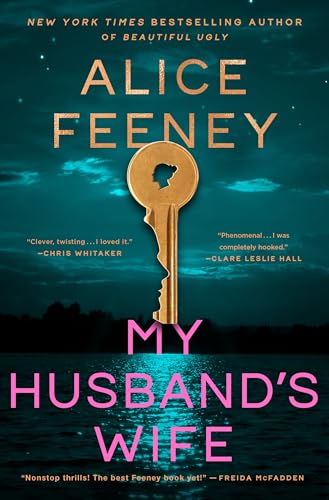
My Husband's Wife
Alice Feeney

The Da Vinci Code
Dan Brown
The Girl on the Train
Paula Hawkins
The Silence of the Lambs
Thomas Harris
Alice Feeney
My Husband's Wife
Alice Feeney
Thriller
Domestic psychological thriller / identity-theft revenge plot
2026
10
7
An artist comes home to find her key no longer fits and a lookalike living as her husband's wife, while a terminally ill London detective who has inherited the same Cornish house arrives to investigate her disappearance, a case she has personal reasons to control.
A woman's identity is erased by people who seem to be persecuting her. The story is actually a revenge plot for a crime she committed a decade earlier, and the reader has been sympathising with the wrong victim.
Gaslight run in reverse, with the investigating detective as the conspirator.
Birdy (DCI Olivia Bird), a detective living under a death sentence from both her diagnosis and Thanatos. She is positioned as the investigator while secretly running the plot she is investigating. Eden holds the protagonist slot in the opening chapters as a decoy.
In the backstory, Eden, who pushed eight-year-old Gabriella down the stairs and staged a hit-and-run so Birdy would blame herself. In the present, Harrison, Mary, and Birdy's conspiracy. Beneath both, Jane Carter, who actually kills Eden.
Character core
To make Eden pay for what she did to Gabriella and to settle it before her predicted death day arrives.
To stop living as though the verdicts on her life have already been delivered: the guilt she accepted for Gabriella's injury and the date Thanatos gave her.
I hurt my daughter, I deserved to lose her, and my ending has already been decided.
She was never guilty of the accident, and the predicted date was not a verdict. She survives 2 November, and her cancer goes into remission.
Exposure of a murder conspiracy led by a serving DCI, the loss of her rebuilt bond with Gabriella, and whatever days she has left.
Structure
Rotating close third-person strands, principally Eden, Birdy, and Sergeant Carter. Present-day sections are date-stamped, and a 'six months earlier' strand follows Birdy. A closing epilogue belongs to Jane Carter, a character the reader has barely registered.
The present-day action compresses into the days between 30 October and 2 November, which is Birdy's predicted death date. The calendar itself is the clock. Eden disappears early, and her strand becomes a record of the gaslighting rather than a live investigation. Birdy's backstory strand runs parallel and withholds the one fact that reorganises everything: she is Harrison's first wife. The book stacks its reversals so each one reassigns guilt. First the impostor, then the conspiracy, then Eden's original crime, and finally a killer outside the conspiracy altogether.
Eden returns from a run to find her key no longer fits Spyglass. A woman who resembles her answers the door, and Harrison tells the police he does not know Eden.
A battered, unrecognisable body washes up, and DNA from a hairbrush at Spyglass does not match it. Carter then corners the impostor at Gabriella's care home: she is Mary Kendall, Gabriella's carer and Harrison's lover. The question shifts from whether Eden is mad to who replaced her and why.
The conspiracy is laid bare to Carter. Birdy, Harrison, and Mary planned to drive Eden to despair and stage her death as suicide. With her predicted death day arriving, Birdy has lost her cover, her investigation, and her future at once.
The backstory is confirmed: Eden, then Gabriella's nanny, was sleeping with Harrison, pushed Gabriella down the stairs, and staged the hit-and-run that Birdy believed she had caused. Birdy insists she did not push Eden off the cliff. On 2 November she overdoses on pills, and Carter revives her with CPR.
A year later Birdy lives at Spyglass in remission, and Gabriella, recovering, visits her from Switzerland, where she lives with Harrison and Mary. Carter keeps quiet in exchange for Harrison paying off his mortgage and has been promoted. An epilogue reveals that his wife Jane pushed Eden off the cliff out of jealousy, and she hints she may act again.
Story beats
| Beat | Where | How it lands |
|---|---|---|
A door closed behind them | Opening, 30 October | The key that no longer fits Spyglass is the door-closed beat made literal. Eden cannot retreat into her own life because it has been occupied. |
Coming home and home is subtly wrong | Opening chapters | Home is not merely wrong but inhabited by a version of Eden in her clothes, borrowing horror's uncanny-house effect for a domestic thriller. |
The truth told and not believed | Eden's strand, first act | Eden tells the truth about who she is to Harrison, Carter, and the village, and the impostor's weeks of groundwork mean nobody believes her. |
Discovering their file has been edited | Eden's strand | Mary has built social-media accounts and village friendships in Eden's name, so the record of her identity has been rewritten before she can defend it. |
A witness who won't speak | The Manor, backstory into present | Gabriella, mute for a decade, holds the truth about the accident. Her first words, denying Eden is her mother, trigger the endgame. |
The killer helping with the search | 31 October onward | Birdy installs herself as Carter's new DCI and leads the search for Eden, the woman her own conspiracy targeted, so every investigation scene carries irony on reread. |
An ally's private agenda surfaces | Late middle | From Carter's side, the boss he trusted and slept with is running the plot, which recasts every scene they shared. |
A countdown that turns out to be fake | 2 November | Thanatos's death date drives Birdy's timeline and her overdose, then proves wrong. The book spent its tension on a clock that was never real. |
A reveal that recontextualizes an earlier scene | Climax | Eden's original crime, the push and the staged hit-and-run, turns her opening victimhood into a mirror of what she did to Birdy. |
Returning to the starting place, changed | One year later | Birdy ends living in Spyglass, the grandmother's house she sold, so the place measures how far she has moved from the woman who expected to die. |
A door closed behind them
The key that no longer fits Spyglass is the door-closed beat made literal. Eden cannot retreat into her own life because it has been occupied.
Coming home and home is subtly wrong
Home is not merely wrong but inhabited by a version of Eden in her clothes, borrowing horror's uncanny-house effect for a domestic thriller.
The truth told and not believed
Eden tells the truth about who she is to Harrison, Carter, and the village, and the impostor's weeks of groundwork mean nobody believes her.
Discovering their file has been edited
Mary has built social-media accounts and village friendships in Eden's name, so the record of her identity has been rewritten before she can defend it.
A witness who won't speak
Gabriella, mute for a decade, holds the truth about the accident. Her first words, denying Eden is her mother, trigger the endgame.
The killer helping with the search
Birdy installs herself as Carter's new DCI and leads the search for Eden, the woman her own conspiracy targeted, so every investigation scene carries irony on reread.
An ally's private agenda surfaces
From Carter's side, the boss he trusted and slept with is running the plot, which recasts every scene they shared.
A countdown that turns out to be fake
Thanatos's death date drives Birdy's timeline and her overdose, then proves wrong. The book spent its tension on a clock that was never real.
A reveal that recontextualizes an earlier scene
Eden's original crime, the push and the staged hit-and-run, turns her opening victimhood into a mirror of what she did to Birdy.
Returning to the starting place, changed
Birdy ends living in Spyglass, the grandmother's house she sold, so the place measures how far she has moved from the woman who expected to die.
Tropes
The gaslighting victim is the guilty party and the gaslighters are the people she wronged, so the book's most sympathetic setup becomes its moral problem.
The threat originates entirely inside a marriage and its predecessor. The crime scenes are a staircase, a front door, and a clifftop walk.
Mary's resemblance to Eden is a pure mechanism: she substitutes for her socially and physically, which is what makes the erasure credible to the village.
Birdy's stake is total, as first wife, mother of the victim, and conspirator. The book conceals this from the reader rather than from the other characters.
Birdy's chapters narrate her investigation while withholding her marriage and her part in the plan, so the unreliability is by omission rather than falsehood.
The visible, unmovable deadline is a corporate death prediction, and surviving it is the resolution rather than beating it.
The epilogue relocates Eden's death outside the conspiracy entirely, so none of the planners is technically her murderer.
Craft notes
The book shows how to invert reader sympathy without cheating. Eden's opening chapters are a textbook innocent-victim setup: locked out, disbelieved, erased. Every one of those techniques is later revealed as a punishment designed to mirror what she did to Birdy. If you plan a sympathy reversal, make the persecution a deliberate echo of the victim's own crime so the reveal reads as design rather than a trick. Give the investigator a withheld relationship to the case, and every procedural scene gains a second meaning on reread.
Feeney's final twist adds a killer from outside the main triangle. Imitators copy the move without its cost: several reviewers found it an escalation too far because Jane has little on-page weight before the epilogue. If your last reveal names a peripheral character, plant them in at least two earlier scenes where their motive is visible but unremarked. Otherwise the twist reads as a fresh fact rather than a reinterpretation of old ones.
Drop this structure into a project, set a daily word goal, and keep the streak. Free 14-day Pro trial, no credit card.