
Blood Meridian
Cormac McCarthy
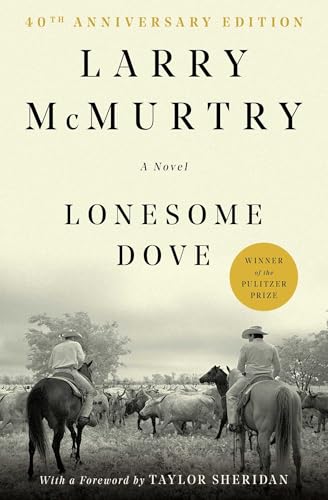
Lonesome Dove
Larry McMurtry

Riders of the Purple Sage
Zane Grey
Shane
Jack Schaefer
True Grit
Charles Portis
Larry McMurtry
Lonesome Dove
Larry McMurtry
Western
Epic western
1985
7
6
Two retired Texas Rangers running a livery stable in a dying border town are talked into stealing a herd of cattle and driving it two thousand miles to Montana, a country neither of them has any real reason to want.
Two old friends drive a stolen herd from Texas to Montana for no better reason than that one of them proposed it.
A cattle-drive novel that is really about two men who have spent forty years failing to say anything true to each other.
Augustus McCrae and Woodrow Call, in opposition throughout.
Blue Duck as the immediate threat; the country itself, and the closing of the frontier, structurally.
Character core
Call wants the drive completed and the ranch established. Gus wants to see Clara again and to talk.
Call needs to acknowledge Newt as his son. Gus needs almost nothing, which is why he is the book's moral centre and why his death costs so much.
Call: what a man does is what he is, and saying things is a waste of daylight.
Never reached. Call carries Gus's body two thousand miles back to Texas because he was asked to, and still cannot say the one sentence Newt needs — the failure is the novel's final judgement on him.
The herd, the crew's lives, Lorena's survival, and — beneath everything — whether either man's life added up to anything.
Structure
Third person, rotating widely — Call, Gus, Newt, Lorena, July Johnson, Roscoe — past tense, giving even minor characters full interiority before killing them.
The trail is the structure and the deaths are the punctuation. McMurtry runs several plots simultaneously — the drive, Lorena's abduction, July Johnson's pursuit, Clara's ranch — that converge and separate along the route. The novel's most-copied trick is that it grants a full point of view to characters who are about to die pointlessly, so that the deaths land as waste rather than as drama.
Jake Spoon rides back into Lonesome Dove with a story about Montana, and Gus decides they are going.
Blue Duck takes Lorena, and Gus rides after her alone — the point at which the drive stops being the novel's subject.
Gus takes arrows in both legs, refuses amputation, and dies in Miles City having extracted the promise about his burial.
Not a confrontation. The climax is Call agreeing to carry the body back, which is a promise made to a dead man at the cost of everything he built the drive for.
Call returns to a Lonesome Dove that has emptied out, having buried Gus in an orchard in Texas, and is described by a stranger as a man of vision — which the novel presents as the cruellest line in it.
Story beats
| Beat | Where | How it lands |
|---|---|---|
A stranger who won't say where they came from | Act I | Jake Spoon returns without explaining what he is running from, and it kills people. |
A horse or vehicle lost, and the walk after | Middle | Horses lost to water moccasins and to weather, and the walking afterwards is where the crew is broken. |
Weather as antagonist for a full chapter | Throughout | A hailstorm, a dust storm, a river, and a snake-filled crossing each get a full chapter and each takes someone. |
Burying someone in ground too hard to dig | Throughout | Graves dug in ground that resists it, repeatedly, with the wrong tools. |
A hanging attended by the whole town | Middle | The hanging of Jake Spoon by his oldest friends is the book's moral crux. |
A reunion that goes badly | Middle | Gus reaches Clara's ranch after seventeen years and finds a woman with a life he is not part of. |
Someone recognized from another life | Throughout | Every rider on the drive is recognised by someone from a life they left. |
A stranger who won't say where they came from
Jake Spoon returns without explaining what he is running from, and it kills people.
A horse or vehicle lost, and the walk after
Horses lost to water moccasins and to weather, and the walking afterwards is where the crew is broken.
Weather as antagonist for a full chapter
A hailstorm, a dust storm, a river, and a snake-filled crossing each get a full chapter and each takes someone.
Burying someone in ground too hard to dig
Graves dug in ground that resists it, repeatedly, with the wrong tools.
A hanging attended by the whole town
The hanging of Jake Spoon by his oldest friends is the book's moral crux.
A reunion that goes badly
Gus reaches Clara's ranch after seventeen years and finds a woman with a life he is not part of.
Someone recognized from another life
Every rider on the drive is recognised by someone from a life they left.
Tropes
The genre's definitive execution, with the procedural detail — river crossings, night herding, remuda management — fully rendered.
Weather and terrain kill more of the crew than any human antagonist.
Clara Allen's horse ranch and her refusal of Gus are among the book's strongest material.
Call and Gus hang their own friend for riding with horse thieves, and the book does not soften it.
The frontier's closure is the elegiac undertone throughout, and Lonesome Dove is already emptying in chapter one.
Present and unflinching, though Blue Duck functions largely as a threat rather than as a full perspective.
Craft notes
McMurtry kills characters mid-sentence and mid-arc. Deets, Sean, Roscoe — each dies with a plan they were partway through, and the reader has spent chapters inside their heads. Death in this book has no narrative decorum, which is precisely what makes the country feel dangerous. If your world is lethal, let it interrupt.
The novel is routinely read as a celebration of the frontier and McMurtry spent decades objecting. Writers borrowing the elegiac register should note that Gus and Call's adventure has ruined nearly everyone in their vicinity, and the book says so repeatedly.
Drop this structure into a project, set a daily word goal, and keep the streak. Free 14-day Pro trial, no credit card.