

Dune
Frank Herbert
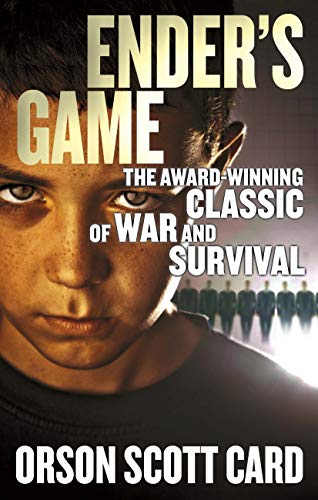
Ender's Game
Orson Scott Card
Neuromancer
William Gibson

Project Hail Mary
Andy Weir

The Martian
Andy Weir
Orson Scott Card
Ender's Game
Orson Scott Card
Sci-Fi
Military science fiction
1985
7
6
A gifted six-year-old is taken to an orbital military academy where the adults systematically isolate him, escalate every challenge past fairness, and train him to command humanity's fleet against an alien species — while concealing what the final exam actually is.
Children are trained as commanders through games, and the last game is not a game.
A boarding-school novel where the school is a weapon and the pupil is the ordnance.
Ender Wiggin — capable of Peter's ruthlessness and Valentine's empathy, and terrified of the first.
Colonel Graff and the International Fleet; the buggers are the ostensible enemy and are barely present.
Character core
To be allowed to stop. To rest, to see Valentine, to not have to hurt anyone again.
To accept that his capacity to understand an enemy completely — which is what makes him lethal — is also what makes him capable of loving them.
If I win decisively enough, they will let me go home.
There was never a version where they let him stop, and the price of the total understanding he achieved is that he committed a xenocide while believing it was practice.
Ostensibly humanity's survival; actually Ender's, since the adults are willing to break him and know it.
Structure
Third person limited on Ender, past tense, prefaced by italicised adult conversations that tell the reader they are engineering his isolation deliberately.
Escalating game structure with adult framing. Each chapter opens with unattributed dialogue between Graff and his colleagues discussing Ender as a project, so the reader knows he is being manipulated while Ender does not. That gap is the book's whole tension — and it is what makes the final reveal land on the reader rather than merely on the character.
The monitor is removed, Ender fights Stilson, and Graff arrives to take him to Battle School on the strength of what he did afterwards.
Ender is given command of Dragon Army and the battle room's rules start changing against him — two battles a day, unfair matchups, no recovery time — which confirms that the game is rigged and that he is the target.
Bonzo in the shower. Ender wins and is not told the boy is dead, and he understands that the adults will let him kill rather than let him lose.
Command School's final simulation. Ender, exhausted and past caring, spends his fleet to destroy the enemy homeworld — and is congratulated for having actually done it.
Ender learns what he has done, finds the hive queen's egg, and becomes the Speaker for the Dead — the book converts its own triumph into an atrocity in the last twenty pages.
Story beats
| Beat | Where | How it lands |
|---|---|---|
A rule change that invalidates their strength | Middle | The battle school changes its rules whenever Ender adapts, invalidating each solution as he finds it. |
Public humiliation that fuels everything after | Act I | Graff engineers Ender's isolation publicly on the shuttle, and the humiliation is a deliberate instrument. |
The rules bent once, then bent again | Throughout | Each escalation by the adults is small and justified, and the cumulative effect is a child broken on purpose. |
Fighting someone who isn't trying | Command School | Ender fights an opponent whose real constraints he has been lied to about. |
Taking on a student they don't want | Late | Ender is given a squadron of his own friends to command and use up. |
Discovering they were never the target | Climax | The exercise Ender thought was a test was the war, and he was never the student. |
They become the thing they feared | Throughout | Ender's terror is that he is Peter, and the book confirms it in the only way that matters. |
A rule change that invalidates their strength
The battle school changes its rules whenever Ender adapts, invalidating each solution as he finds it.
Public humiliation that fuels everything after
Graff engineers Ender's isolation publicly on the shuttle, and the humiliation is a deliberate instrument.
The rules bent once, then bent again
Each escalation by the adults is small and justified, and the cumulative effect is a child broken on purpose.
Fighting someone who isn't trying
Ender fights an opponent whose real constraints he has been lied to about.
Taking on a student they don't want
Ender is given a squadron of his own friends to command and use up.
Discovering they were never the target
The exercise Ender thought was a test was the war, and he was never the student.
They become the thing they feared
Ender's terror is that he is Peter, and the book confirms it in the only way that matters.
Tropes
State selection of children for military use, presented as ordinary policy.
The simulation's status is the twist, and the mind game supplies a second, stranger version.
The buggers barely appear, and the final reveal reframes the entire war as a communication failure.
Ender's parents consent to his removal, and their absence is state policy rather than accident.
The battle room's standings and rankings structure the whole middle of the book.
Stilson, Peter, and Bonzo form an escalating sequence, and each is resolved with disproportionate violence.
Craft notes
Card's twist is fair because the reader has been told, in every chapter opening, that the adults are lying to Ender about everything. The reader is invited to distrust the frame and still does not anticipate the specific deception. Give your reader a general warning and they will not guess the particular — and they will not feel cheated when it arrives.
The battle-room sequences are frequently copied as tactical set pieces. Their actual function is to demonstrate escalating unfairness — each victory is answered by a rule change — so that the reader accumulates evidence of institutional cruelty. Tactics without that pattern are just chess.
Drop this structure into a project, set a daily word goal, and keep the streak. Free 14-day Pro trial, no credit card.