
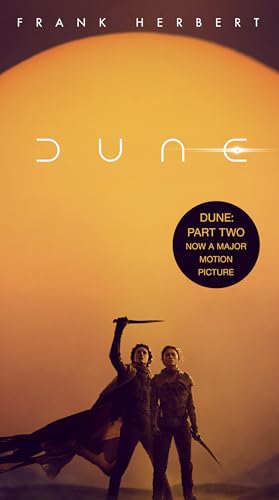
Dune
Frank Herbert
Ender's Game
Orson Scott Card
Neuromancer
William Gibson

Project Hail Mary
Andy Weir

The Martian
Andy Weir
Frank Herbert
Dune
Frank Herbert
Sci-Fi
Space opera / political science fiction
1965
7
6
When his family is granted stewardship of the desert planet that is the sole source of the substance interstellar civilisation depends on, a duke's son survives the trap that destroys his house and becomes the messiah of the planet's native people.
A noble house is handed a poisoned prize, and the surviving heir takes up a religion that was manufactured for him centuries in advance.
A dynastic political thriller in which the hero's victory is also the book's warning.
Paul Atreides — trained, prescient, and increasingly unable to find a future that does not include a holy war fought in his name.
The Harkonnens and Emperor Shaddam IV in the plot; the Bene Gesserit's engineered religion and Paul's own prescience underneath it.
Character core
To survive, avenge his father, and take back what was taken from his house.
To recognise that the instrument of his revenge is a population whose faith was manufactured to be used, and that his victory will kill billions.
I can take the power I need and stop short of the thing I have foreseen.
The jihad is not avoidable by winning. Every path through the prescient vision that keeps him alive also releases it, and accepting the throne is choosing it.
The Atreides line, control of the spice, and — in the register that matters — a religious war across the known universe.
Structure
Third person, moving fluidly between characters within a scene — including antagonists — with italicised interior thought. The technique is unfashionable and deliberate: Herbert wants the reader to know what everyone at the table is thinking.
Three books in one volume, tracking the destruction of House Atreides, Paul's absorption into the Fremen, and the imperial reckoning. Chapter epigraphs from Irulan's later histories tell the reader the outcome in advance, which converts suspense into dread — the reader knows Paul wins and spends the book learning what winning costs.
The Emperor grants Arrakis to House Atreides, which everyone at the table understands to be a trap.
Yueh's betrayal, Leto's death, and Paul and Jessica's flight into the deep desert, where Paul's prescience opens fully and he sees the jihad for the first time.
Paul takes the Water of Life. He is nearly killed, Alia is transformed in the womb, and the vision confirms that there is no branch in which the war does not happen.
The assault on Arrakeen behind a sandworm cavalry, the duel with Feyd-Rautha, and the Emperor's submission secured by a threat to destroy the spice.
Paul takes the throne and the reader understands, as he does, that the ending is a beginning of something much worse. The last line belongs to Jessica, and it is about Chani.
Story beats
| Beat | Where | How it lands |
|---|---|---|
A favor called in at the worst possible time | Throughout | Old obligations between houses, and Yueh's conditioning, determine the entire first act's betrayal. |
The prophecy fulfilled by the wrong person, technically | Middle | The Lisan al-Gaib prophecy is fulfilled by a foreigner using an implanted legend, exactly as designed. |
The plan works and solves nothing | Resolution | Paul takes the throne and it solves none of the problem he actually cares about. |
Rationing decided by a formula | Throughout | Water discipline governs Fremen society, and the rationing formula is a whole civilisation's ethics. |
Discovering the villain's cause is just | Late | Paul comes to understand that his enemies' assessment of him was accurate. |
An offer they should refuse and don't | Climax | The Fremen offer him a role he could refuse, and does not. |
Crossing a border where the rules of magic change | Act II | Crossing into the deep desert changes what is possible and what Paul is. |
A favor called in at the worst possible time
Old obligations between houses, and Yueh's conditioning, determine the entire first act's betrayal.
The prophecy fulfilled by the wrong person, technically
The Lisan al-Gaib prophecy is fulfilled by a foreigner using an implanted legend, exactly as designed.
The plan works and solves nothing
Paul takes the throne and it solves none of the problem he actually cares about.
Rationing decided by a formula
Water discipline governs Fremen society, and the rationing formula is a whole civilisation's ethics.
Discovering the villain's cause is just
Paul comes to understand that his enemies' assessment of him was accurate.
An offer they should refuse and don't
The Fremen offer him a role he could refuse, and does not.
Crossing a border where the rules of magic change
Crossing into the deep desert changes what is possible and what Paul is.
Tropes
The Landsraad, the Guild, and CHOAM make imperial politics an economic system rather than a backdrop.
The prophecy is a Bene Gesserit product and Paul knows it, which makes his acceptance a political act.
Prescience is a trap: seeing the futures does not give Paul a way out of them.
The Fremen ecological project is the book's quiet second plot and its real long game.
Leto's death is a chosen sacrifice that achieves almost nothing tactically.
And the book flags in advance that the successful rebellion will be worse than the empire.
Craft notes
Herbert tells you the ending in the epigraphs and it does not reduce the tension at all. Foreknowledge changes the question from what happens to how and at what cost, which is a stronger engine for a political novel than surprise. If your plot is inevitable, consider announcing it.
Dune is routinely read as a straightforward chosen-one narrative, which is precisely the reading Herbert spent the sequel correcting. Writers borrowing the messiah structure should note that the Bene Gesserit planted the prophecy, the Fremen were prepared to receive it, and Paul knows all of this while accepting it anyway.
Drop this structure into a project, set a daily word goal, and keep the streak. Free 14-day Pro trial, no credit card.