
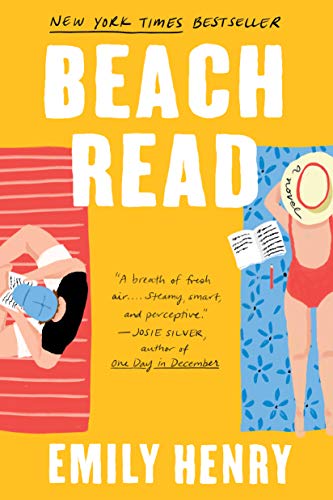
Beach Read
Emily Henry

It Ends with Us
Colleen Hoover

Pride and Prejudice
Jane Austen
Red, White & Royal Blue
Casey McQuiston
The Hating Game
Sally Thorne
Emily Henry
Beach Read
Emily Henry
Romance
Contemporary romance
2020
7
6
A romance novelist who has stopped believing in happy endings inherits her late father's lake house, discovers her college rival — a literary novelist with writer's block — living next door, and makes a bet that they will swap genres for the summer.
Two blocked writers agree to write each other's books, and each has to inhabit the worldview they have been dismissing.
A romantic comedy about genre itself, with grief as the substrate.
January Andrews — a romance writer whose father's affair and death have destroyed her belief in the thing she sells.
Grief, and the version of her parents' marriage she can no longer maintain.
Character core
To finish a book, pay her bills, and sell the lake house without having to think about what it was for.
To let the good and the ugly versions of her father coexist, rather than deciding which one was real.
My father's affair means the marriage was a lie, my whole childhood was a performance, and happy endings are a product I no longer believe in.
Both things were true at once. The marriage was loving and it was compromised, and refusing that complexity is what has made her unable to write.
Financial: a book she cannot write and a house she cannot afford. Emotional: whether she gets to keep her memory of her father.
Structure
First person past tense on January, whose voice is funny in a way that is visibly doing work to avoid a subject.
The genre-swap bet supplies a structure that is also the theme: January must write something bleak, Gus must write something hopeful, and their research trips become the dating structure. Each excursion doubles as a scene for one of their books and a step in the relationship, which is an unusually economical design.
January arrives at the lake house she inherited and finds Gus Everett on the neighbouring deck.
The research trips get personal — Gus's material takes them to a cult's survivors, hers to conventional romantic set-pieces — and each is confronted with what the other's genre actually requires of a writer.
The disclosure about Gus's marriage and his conviction that he ruins things intersects with January's inability to trust a hopeful ending, and both retreat into their respective theses.
January chooses the ending she does not believe in, in her book and in her life, which is the same decision made twice.
Both books get written. The house is dealt with. The romance resolves without pretending the grief has.
Story beats
| Beat | Where | How it lands |
|---|---|---|
Forced proximity: weather, breakdown, cancelled flight | Throughout | Adjacent decks with a shared sightline make avoidance impossible without either party doing anything. |
Discovering a parent's letters or debts | Middle | Her father's letters and the second house deliver the affair as evidence rather than as rumour. |
A skill taught: knots, chords, recipes, language | Middle | Each teaches the other their genre's craft, and the lessons are genuine writing instruction. |
One asks a question nobody's asked them before | Middle | Gus asks January a question about her work that nobody has asked her, and it reframes her block. |
The ex reappears — and is decent | Middle | Naomi reappears and is not a villain, which forecloses the easy version of Gus's history. |
The house sold | Throughout | The lake house must be sold, and every scene in it is on a clock. |
A quiet ordinary morning | Late | An ordinary morning of two people writing in the same room is the book's actual romantic climax. |
Forced proximity: weather, breakdown, cancelled flight
Adjacent decks with a shared sightline make avoidance impossible without either party doing anything.
Discovering a parent's letters or debts
Her father's letters and the second house deliver the affair as evidence rather than as rumour.
A skill taught: knots, chords, recipes, language
Each teaches the other their genre's craft, and the lessons are genuine writing instruction.
One asks a question nobody's asked them before
Gus asks January a question about her work that nobody has asked her, and it reframes her block.
The ex reappears — and is decent
Naomi reappears and is not a villain, which forecloses the easy version of Gus's history.
The house sold
The lake house must be sold, and every scene in it is on a clock.
A quiet ordinary morning
An ordinary morning of two people writing in the same room is the book's actual romantic climax.
Tropes
The college rivalry is real but mild; the actual obstacle is two incompatible theories of how stories should end.
Neighbouring houses rather than a shared room — proximity as geography, sustained across a whole summer.
Both are self-employed, so the professional stakes are creative rather than institutional.
January's father is not redeemed or condemned, and the book ends with both accounts intact.
Both manuscripts are discussed, drafted, and thematically load-bearing.
The opposition is aesthetic and philosophical rather than temperamental, which is a more durable version.
Craft notes
Henry makes the protagonist's professional problem and her emotional problem the same problem, so that fixing the manuscript and fixing the grief are one action. That is the tightest possible want-need construction. If your character has a job, ask whether their creative or professional block can be made identical to their internal lie.
Romantic comedies frequently treat a dead parent as backstory that supplies motivation and then stays put. Here the father's letters, the second house, and the woman he loved are all present, active, and complicating — the grief has a plot.
Drop this structure into a project, set a daily word goal, and keep the streak. Free 14-day Pro trial, no credit card.