
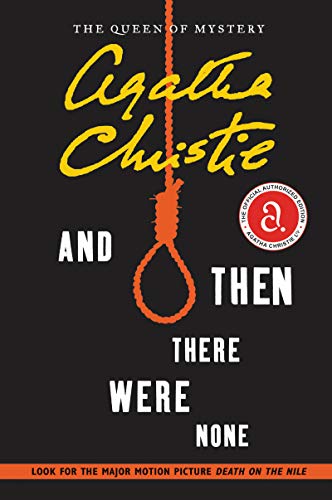
And Then There Were None
Agatha Christie

The Girl with the Dragon Tattoo
Stieg Larsson
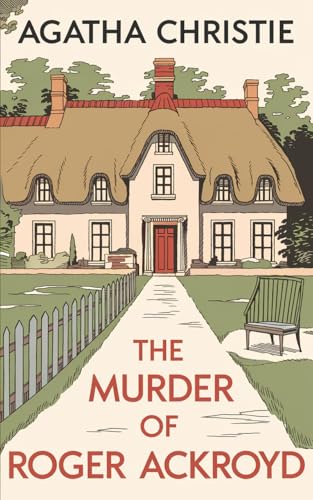
The Murder of Roger Ackroyd
Agatha Christie

The Thursday Murder Club
Richard Osman

Where the Crawdads Sing
Delia Owens
Agatha Christie
And Then There Were None
Agatha Christie
Mystery
Closed circle / suspense
1939
6
6
Ten strangers are lured to an island off the Devon coast by a host who never appears, accused by a recording of deaths they each escaped punishment for, and killed one by one in the order of a nursery rhyme.
Ten guilty people are executed on an island by one of the ten.
The purest closed-circle mystery ever written, and the origin of most of what followed.
Vera Claythorne functions as the emotional centre, though the ensemble is the true subject.
Justice Wargrave, concealed within the rotating viewpoint the entire time.
Character core
Each guest wants to survive and to avoid having their past examined.
The book denies its cast any redemption. The argument is that each has escaped a justice they deserved, and the plot is that justice arriving.
My case was different. What I did was not really murder.
Reached individually and uselessly as each character breaks down: the accusations are accurate, and there is no version of the story in which they are innocent.
Ten lives, and — for Vera especially — the psychological collapse that precedes the last death.
Structure
Third person, rotating among the guests, past tense, with a final epistolary confession. The rotation includes the murderer's viewpoint, which is the technical achievement.
The nursery rhyme is the outline. The reader knows the sequence and the count, so every chapter arrives with a published expectation, and the tension is entirely in method and identity. Christie shrinks the suspect pool in real time, which is a structure that generates acceleration automatically.
The gramophone recording accuses each guest by name, and the first of them dies at dinner.
The guests confirm there is nobody else on the island, which converts a murder mystery into mutual suspicion and makes cooperation impossible.
The remaining survivors cannot construct any safe arrangement — sleeping, eating, and grouping are all lethal — and the social order dissolves entirely.
Vera, alone and psychologically dismantled, walks into the prepared ending under her own power.
The police find ten bodies and no explanation. Wargrave's confession, recovered from a bottle at sea, supplies the solution the investigation could not.
Story beats
| Beat | Where | How it lands |
|---|---|---|
Counting the group and getting the wrong number | Middle | Counting the group is a recurring, futile ritual — the arithmetic is correct and the conclusion is still wrong. |
The group turns on the most frightened member | Middle | The group turns on its most frightened members, which accelerates the killer's work. |
A confession from the wrong person | Late | A death staged as a confession redirects suspicion at exactly the right moment. |
Splitting up for a genuinely sound reason | Middle | Splitting up is repeatedly the rational decision and repeatedly fatal. |
The phone works, and nobody believes them | Act I | The boat does not come, and the mainland's indifference is established before anyone dies. |
The victim was genuinely unpleasant | Throughout | Every victim is genuinely culpable, which complicates the reader's sympathy on purpose. |
Counting the group and getting the wrong number
Counting the group is a recurring, futile ritual — the arithmetic is correct and the conclusion is still wrong.
The group turns on the most frightened member
The group turns on its most frightened members, which accelerates the killer's work.
A confession from the wrong person
A death staged as a confession redirects suspicion at exactly the right moment.
Splitting up for a genuinely sound reason
Splitting up is repeatedly the rational decision and repeatedly fatal.
The phone works, and nobody believes them
The boat does not come, and the mainland's indifference is established before anyone dies.
The victim was genuinely unpleasant
Every victim is genuinely culpable, which complicates the reader's sympathy on purpose.
Tropes
The defining example. The circle is verified empty and never leaks.
Weather and geography remove rescue, and the removal is established before the killing starts.
The murderer's chapters are included and honest — the concealment is achieved without a single false statement.
Paranoia rather than the murders does most of the psychological damage.
Delivered as a document after the investigation has formally failed.
Wargrave's motive — a judicial temperament with no legal outlet — is the book's actual argument.
Craft notes
The rhyme is the book's most-copied device and its least understood. It functions as a promise with a schedule: the reader is told what is coming and cannot prevent it, which converts suspense into dread. If you want sustained tension without withholding, publish the plan and let the reader watch it be kept.
Later closed-circle books cheat by adding an eleventh person. Christie's absolute constraint — the island is verified empty, repeatedly, by the characters — is why the paranoia works, and abandoning it forfeits everything the structure offers.
Drop this structure into a project, set a daily word goal, and keep the streak. Free 14-day Pro trial, no credit card.